
Your ledger entry, programmable.
A bank deposit that moves at 02:00 on a Sunday — and never leaves the bank.
Fiat-on-Chain binds regulated money to the ledger that already holds it and settles any asset against it in central bank money. Nothing leaves your balance sheet. Nothing needs a reserve, a data feed or a bridge.
- Written to the CPMI-IOSCO principles
- Reference implementation v1.0.0-rc.1
- NBG tokenized-instrument sandbox: proposed
Regulator's view · one bank's tokens · one bar per minute
minute 1,042 · tokens = ledger · difference 0
Your regulator reads this from a computer it runs. Every minute, the tokens in existence are proven equal to your ledger — and if they ever were not, token creation would stop by itself.
reserve pools
The token is your own liability, bound to your own ledger. There is no pool of money to fund, custody or audit.
reserve data feeds
You write the fact yourself, as the posting. Only outside prices — an FX rate, say — need a signed source.
token bridges
Cross-currency and cross-asset settle both sides at once, on the rail. No substitute token, ever.
Who it is for
Enter under the license you already hold.
One protocol, four roles. Each keeps its regulator, its balance sheet and its customer.
Banks
Your corporate deposits become settlement-final, 24/7, programmable money — on your books, lendable, insured, under your supervisor.
For banksPayment institutions
Safeguarded client funds become tokens without changing the safeguarding. Settle instantly with every bank on the network.
For payment institutionsExchanges & marketplaces
On- and off-ramp becomes a transfer between a supervised issuer and your account: final in seconds, no de-peg, no third-party reserve.
For participantsCentral banks & supervisors
A read-only node that sees every proof, settlement and rule decision as it happens. Halts and resolution orders are yours to sign.
For regulators
Who fits where
Four roles. Every financial institution fits one.
Issuers are few and licensed; participants are many. Most institutions — and most of a bank's clients — are participants.
Issuers
Banks, payment and e-money institutions, credit unions and cooperative banks, broker-dealers holding client money where the regime allows. They hold money under a license and issue tokens of their own liabilities.
Participants
Asset managers and funds, broker-dealers and venues, insurers and pension funds, FX dealers, trade-finance and remittance companies, fintech lenders, exchanges, marketplaces, corporate treasuries. They hold and move tokens through an issuer’s account.
Asset legs
Central securities depositories, transfer agents, fund registrars, tokenization platforms, custodians acting as registers, central counterparties. They keep the register and settle delivery-versus-payment.
Money legs and supervisors
Central banks as settlement authority and supervisor; designated settlement banks where direct access is unavailable; financial intelligence units reading the policy-decision stream.
Two limits by design: only licensed holders of money can issue, so every token is a claim on a supervised balance sheet; and each institution's regulatory obligations stay its own — identity attestation speeds onboarding under its rules; it does not replace them.
How it works
The mint is the posting.
Three mechanisms replace the reserve, the monthly audit and the bridge.
One atomic event
Your core posts a credit and the token is created in the same event; the posting stays pending until the network confirms, and is reversed through ordinary core mechanics if it does not. Two independent keys in your own hardware must both sign — a single broken system cannot create money.
Proven every minute
Tokens in existence are proven equal to your ledger’s balance at every settlement cycle. No customer data leaves your perimeter. Reconciliation becomes an invariant.
Settled in central bank money
Between institutions, value moves by destroy → settle → create, all or nothing, with finality from the banks and the central bank together. Any asset settles against it.
Evidence
Built, not proposed.
The reference implementation is at release candidate and runs the whole protocol on a four-validator permissioned network — with the central bank's roles in the room.
- Two issuers on two licenses — a bank's deposit tokens and a payment institution's safeguarded funds, settling with committed confirmations on every receipt.
- Two currencies — lari and pounds, settled against each other with escrows that provably never outlive their deadlines.
- A bank failure, rehearsed — frozen, customers moved to another bank, both banks proving valid, the record acknowledged by the supervisor.
- Release candidate, frozen for third-party audit and formal verification
- v1.0.0-rc.1Release candidate, frozen for third-party audit and formal verification
- Conformance cases across four harnesses in three languages
- 1,083Conformance cases across four harnesses in three languages
- Confirmations on every receipt — one of them the central bank’s
- 3 of 4Confirmations on every receipt — one of them the central bank’s
- Contract to first token, on the messages your core already emits
- 90 daysContract to first token, on the messages your core already emits
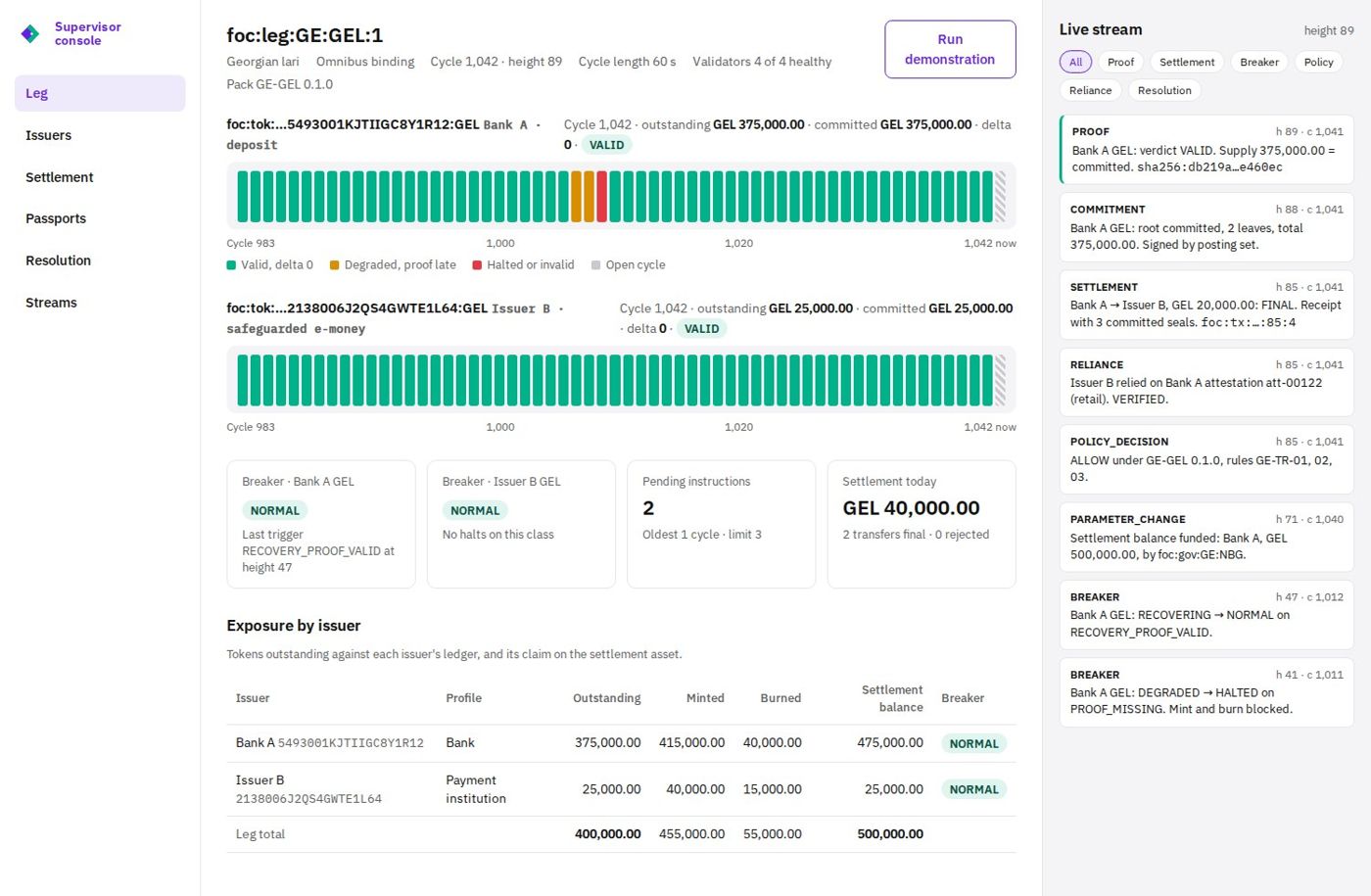
The regulator's screen
What your supervisor sees — continuously.
One screen for three audiences: the central bank sees its own tool, a bank sees what its regulator will see, an investor sees the moat.
Georgia first
A central bank in the room.
The first network launches under the National Bank of Georgia’s tokenized-instrument sandbox: a bank issuer under letter of intent, a payment-institution issuer and a participant platform to be confirmed, and the central bank on the supervisor node, with its settlement-leg role proposed and subject to sandbox design and approval.
“The two ledgers were never allowed to be two.”
Every design decision follows from that sentence. Customers keep their bank. Banks keep their deposits, their systems and their regulator. The central bank keeps the final word.
Keep the deposit. Add the capability.
A ninety-minute briefing for your treasury, technology and compliance leads. You leave with a joint business-case template, the counsel briefing pack and a sandbox environment to test against.