
For central banks and supervisors
Designed against the objectives you have already published.
Singleness of money. Settlement finality. No new run risk. A resolution path. And more visibility than any periodic report.
Objectives and how the design delivers them
Your objective
Singleness of money
- How the design delivers it
- Every token is a par liability of a supervised issuer; inter-issuer settlement at par in central bank money; no secondary market in the token.
Your objective
Settlement finality
- How the design delivers it
- Deterministic finality from a validator set that includes you; every settled transfer carries a receipt with the validators’ committed confirmations.
Your objective
No new run risk
- How the design delivers it
- No reserve pool; a bank-token run is a deposit run under the existing insurance, liquidity and lender-of-last-resort regime.
Your objective
Supervisory visibility
- How the design delivers it
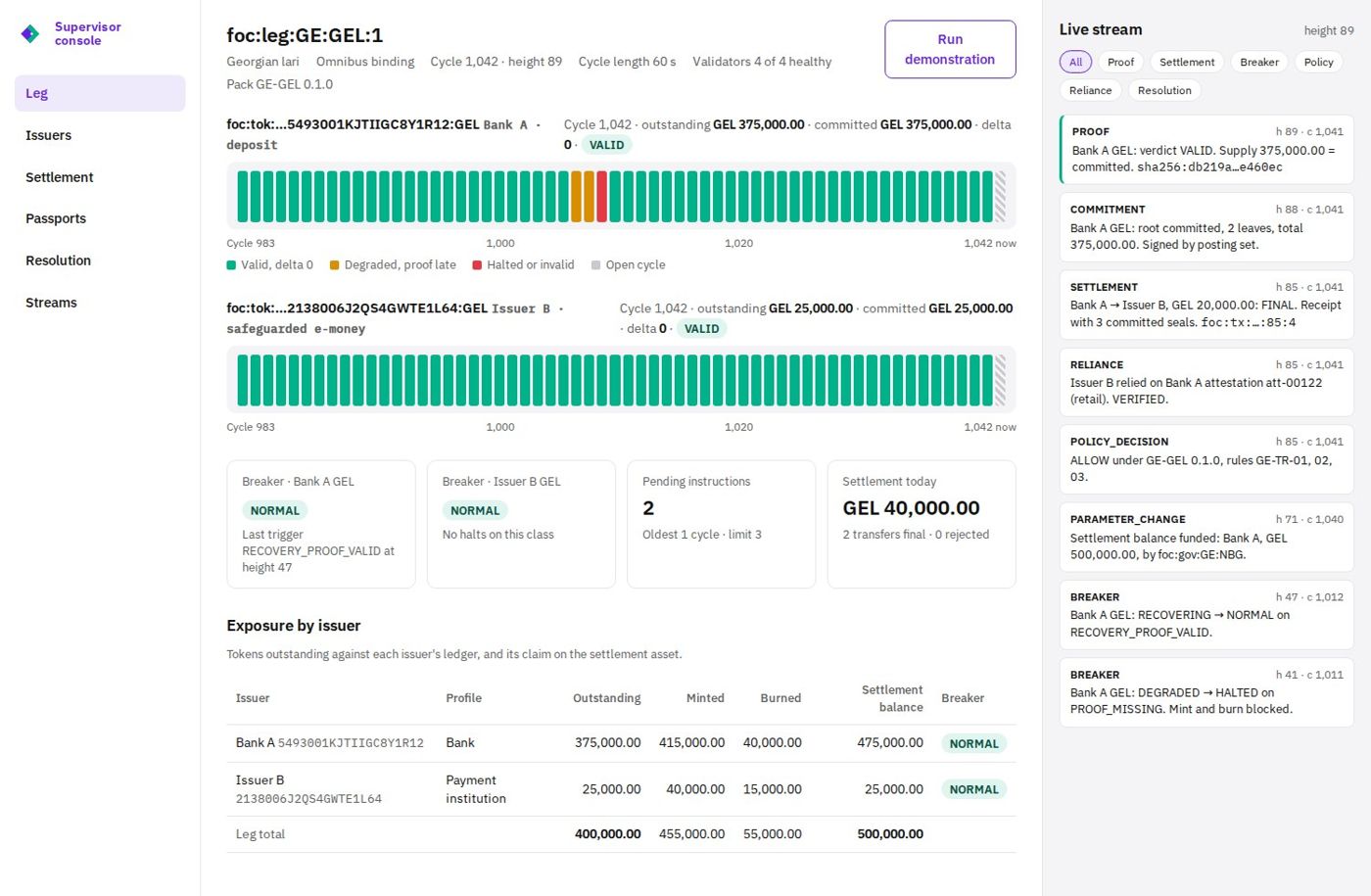
- You run a read-only node that receives every commitment, proof, settlement, rule decision, breaker event and resolution event as it occurs, and can query supply against committed balances, exposure by issuer and pending-instruction aging.
Your objective
AML/CFT
- How the design delivers it
- Jurisdiction rules enforced at the token; attestation status carried by an identity attestation with no personal data; enforcement visible to you.
Your objective
Resolution
- How the design delivers it
- Freeze, snapshot, book transfer and wind-down are protocol primitives; a rehearsal executed on the network is acknowledged by you and recorded on-ledger.
Your objective
Open standard, no operator capture
- How the design delivers it
- The specification is public; a Member Council of issuers with you as observer holds binding rulebook rights; the operator’s source is in escrow and a successor can be appointed on failure.
| Your objective | How the design delivers it |
|---|---|
| Singleness of money | Every token is a par liability of a supervised issuer; inter-issuer settlement at par in central bank money; no secondary market in the token. |
| Settlement finality | Deterministic finality from a validator set that includes you; every settled transfer carries a receipt with the validators’ committed confirmations. |
| No new run risk | No reserve pool; a bank-token run is a deposit run under the existing insurance, liquidity and lender-of-last-resort regime. |
| Supervisory visibility | You run a read-only node that receives every commitment, proof, settlement, rule decision, breaker event and resolution event as it occurs, and can query supply against committed balances, exposure by issuer and pending-instruction aging. |
| AML/CFT | Jurisdiction rules enforced at the token; attestation status carried by an identity attestation with no personal data; enforcement visible to you. |
| Resolution | Freeze, snapshot, book transfer and wind-down are protocol primitives; a rehearsal executed on the network is acknowledged by you and recorded on-ledger. |
| Open standard, no operator capture | The specification is public; a Member Council of issuers with you as observer holds binding rulebook rights; the operator’s source is in escrow and a successor can be appointed on failure. |
The protocol is written against the CPMI-IOSCO Principles for Financial Market Infrastructures; the full mapping is in the specification.
The supervisor node
No regulator has this today.
Delivered configured, before the first token; the two supervisory write paths — halt and resolution order — are signed with your own key.
The settlement asset
Your money, two ways.
A pooled settlement account at the central bank, represented one-to-one on the ledger with your signer controlling minting and redemption; or synchronization with your existing RTGS, where the ledger holds no asset and settlement waits for your signed confirmation. The protocol treats either as an interface; the design of the leg does not change above it.
“Nothing in the protocol holds, issues or bridges money. It moves signed facts and settles in yours.”
Book a supervisor-node demonstration.
Thirty minutes, on the reference network: a bank posting becomes a token, the minute closes, the proof verifies, a payment settles with your seal on it, and a bank failure is rehearsed — with the queries on your screen throughout.